
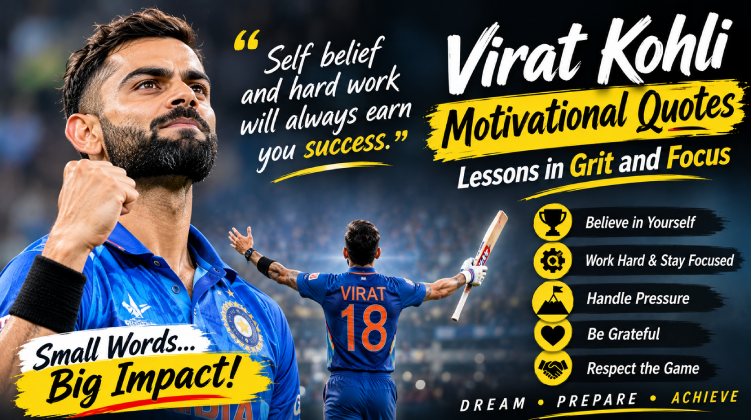
Virat Kohli’s most meaningful motivational quotes focus on a simple idea: progress comes from self-belief, disciplined work and the willingness to face pressure without losing one’s identity. His words resonate beyond cricket because they speak to the daily habits behind long-term achievement—turning up, respecting the process and learning from difficult moments.
Why Kohli’s words connect with so many people
Motivational lines are easy to share but harder to live by. What makes Kohli’s quotes stand out is their emphasis on action rather than easy promises. They do not suggest that confidence alone is enough, or that talent can replace preparation. Instead, they repeatedly bring the conversation back to hard work, passion, fitness and responsibility.
That perspective is useful for students preparing for exams, young athletes working towards selection, professionals building a career and anyone trying to become more consistent. A good quote cannot complete the work, but it can clarify the attitude needed to begin it. The most useful lines are the ones that encourage a person to focus on controllable efforts rather than comparisons or outside noise.
Quotes on self-belief and hard work
“Self belief and hard work will always earn you success.”
This is one of Kohli’s best-known messages. It brings together two qualities that must work side by side. Belief without effort can become wishful thinking, while hard work without faith in one’s ability can make setbacks feel final. The point is not that results arrive instantly, but that confidence grows when preparation becomes a habit.
For a young cricketer, this could mean practising basic skills even when there is no match approaching. For a student, it could mean making a realistic timetable and following it over several weeks. Self-belief is strengthened not only through positive thinking but also through evidence: the knowledge that one has put in honest work.
“Whatever you want to do, do it with full passion and work really hard towards it. Don’t look anywhere else.”
This line is a reminder to protect attention. It is easy to lose focus by constantly checking what others are doing, comparing one’s progress or shifting goals too often. Passion is not merely excitement at the beginning of a journey; it is the commitment to stay engaged after the novelty fades.
“Don’t look anywhere else” can be understood as a call to concentrate on one’s own task. It does not mean ignoring advice or refusing to learn. Rather, it means avoiding distractions that do not improve performance. A person who keeps returning to the next useful action is usually in a stronger position than one who spends too much time worrying about competition.
“Don’t glorify your hard work as a struggle. Struggle is for those who don’t have food to eat. Be grateful if you’re doing what you love.”
This quote offers a valuable distinction between effort and hardship. Training, studying or working towards a goal can be demanding, but Kohli’s message asks people to keep perspective. When a person has an opportunity to pursue something meaningful, effort can also be a privilege.
Gratitude does not reduce ambition. In fact, it can make discipline more sustainable. Instead of treating every early morning, practice session or difficult assignment as a burden, people can see it as a chance to improve. This change in outlook can prevent motivation from depending only on praise, results or convenience.
Quotes on pressure and failure
“I love playing under pressure. In fact, if there’s no pressure, then I’m not in the perfect zone.”
Pressure often arrives before an important exam, a job interview, a presentation or a close match. Many people interpret nervousness as proof that they are not ready. This quote presents another possibility: pressure can mean that the moment matters and that full concentration is required.
The useful lesson is not to pretend that pressure feels comfortable. Instead, it is to prepare well enough that pressure becomes a signal to focus. Deep breathing, a simple pre-performance routine and attention to the immediate task can make a high-stakes moment more manageable. In cricket, that may be watching the next ball closely; in everyday life, it may be completing the next small step rather than worrying about the final outcome.
“I like to be myself, and I don’t pretend.”
Failure often becomes worse when a person tries to imitate someone else’s style, personality or path. Kohli’s line highlights the importance of authenticity. Being oneself does not mean refusing to improve; it means understanding one’s natural strengths and being honest about areas that need work.
Authenticity can also make recovery from setbacks easier. When people are guided by their own values, they are less likely to treat one poor result as a verdict on their worth. They can acknowledge disappointment, assess what went wrong and return to the process. This is a healthier response than creating a false image of constant confidence.
“Whatever I am, it’s natural… I don’t have to pretend to be aggressive.”
The message here is closely related to self-awareness. Different people respond to challenges differently. One athlete may be outwardly expressive, while another stays quiet. One student may learn best through detailed notes, while another learns through discussion and practice. Copying a successful person’s visible habits does not automatically produce the same results.
The more useful approach is to identify what helps one perform with clarity and discipline. A competitive attitude can be genuine without becoming disrespectful, and confidence can be strong without becoming arrogant. Knowing that difference matters in sport, work and relationships.
Quotes on fitness, confidence and attitude
“A fit body gives you confidence.”
Fitness is not only about appearance or sporting performance. It can support energy, routine and self-trust. When people keep promises to themselves—whether that means walking regularly, sleeping properly, training consistently or eating more thoughtfully—they often feel more capable in other parts of life too.
Kohli’s observation also suggests that confidence has a physical side. Preparation affects posture, energy and composure. Of course, fitness goals should be realistic and personal rather than based on comparison. Sustainable habits matter more than extreme routines that cannot be maintained.
“There’s nothing more impressive than a great attitude, which you can wear on your sleeve.”
A good attitude is visible in how someone responds to errors, criticism and competition. It includes respect for teammates, opponents and the task itself. In practical terms, it may mean accepting a coach’s feedback, returning to practice after a poor performance or speaking constructively after a disagreement.
For readers who follow cricket closely, attitude also shapes how matches are understood. Discussions about form, leadership and decision-making are more useful when they consider preparation and context rather than just one result. Those analysing possible match roles may look at today dream11 team captain and vice captain as part of a broader conversation about responsibility and performance under pressure.
“You’ll have to remember the difference between being rude and being confident.”
Confidence is often misunderstood as loudness or dominance. Kohli’s quote draws a necessary boundary: self-assurance should not require disrespect. A confident person can communicate directly, compete strongly and set high standards while still treating others fairly.
This distinction is especially relevant for young people who want to develop leadership skills. Real leadership combines belief with accountability. It allows people to express opinions, make decisions and take responsibility when things go wrong. Rudeness, by contrast, usually weakens trust and distracts from the goal.
Quotes on respect for cricket and inspiration
“In the game of cricket, a hero is a person who respects the game and does not corrupt the game.”
This is a reminder that sporting achievement is not measured only by runs, wickets or trophies. Respect for the rules, the opposition and the spirit of competition also matters. Cricket depends on trust in officials, teammates and opponents, which is why integrity remains central to how players are remembered.
The lesson applies beyond sport. Success achieved without fairness has limited value. People build lasting reputations through the choices they make when no one is applauding: being honest, keeping commitments and treating others with dignity.
“The bat is not a toy, it’s a weapon. It gives me everything in life.”
The force of this statement comes from the respect it shows for a craft. For a cricketer, the bat represents years of practice, opportunity and purpose. For others, the equivalent could be a book, a musical instrument, a camera, a tool kit or a laptop. The object itself is not magical; its value comes from the discipline and dreams attached to it.
Treating one’s tools seriously can improve focus. It encourages people to arrive prepared, take care of equipment and value the skills they are developing. Commitment becomes easier to sustain when the work is connected to a deeper sense of purpose.
“Becoming an inspiration for kids is great. I want to inspire them to do whatever they want.”
This quote shifts the emphasis away from copying a celebrity and towards personal ambition. Inspiration should help people discover their own goals, not pressure them to follow someone else’s path. A child may admire a cricketer yet choose to become a teacher, artist, scientist or entrepreneur. The shared lesson is to pursue the chosen path with sincerity.
The lasting lesson behind these quotes
Virat Kohli’s motivational quotes are most powerful when treated as reminders for everyday action rather than slogans. Self-belief needs hard work, fitness supports confidence, pressure can sharpen focus and authenticity makes growth more sustainable. The common thread is clear: respect the process, remain grateful for the opportunity and keep working even when results take time.