
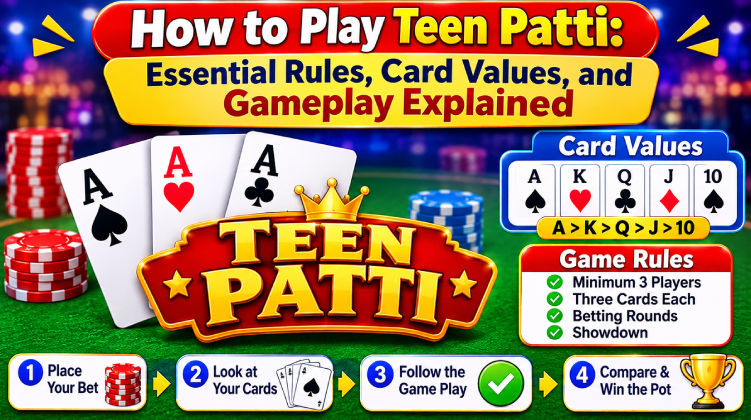
Teen Patti is a traditional three-card game that has become popular among card game enthusiasts because of its simple rules and interesting combinations. Played with a standard 52-card deck, the game involves understanding card rankings, making decisions, and following a structured betting process.
Beginners often search for information about how to play teen patti because learning the basic rules makes the game easier to understand. Another important topic is teen patti probability, which explains the mathematical chances of receiving different card combinations. By exploring these two subjects, beginners can gain a better understanding of the game’s structure, rules, and mathematical background.
Teen Patti Probability: The Chances of Different Card Combinations
Teen patti probability refers to the mathematical likelihood of receiving a particular three-card combination from a standard deck. Understanding probability helps explain why some hands are more common while others are relatively rare.
A standard deck contains 52 cards, and each player receives three cards. The total number of possible three-card combinations is 22,100. This calculation is based on selecting three cards without considering their order.
A Trail has 52 possible combinations, while a Pure Sequence has 48 combinations. An ordinary Sequence has 720 possible combinations. A Color has 1,096 combinations, and a Pair has 3,744 combinations. The remaining 16,440 combinations are High Card hands.
These numbers demonstrate that different card combinations have different probabilities. For example, receiving a High Card is much more common than receiving a Trail.
Learning teen patti probability provides a mathematical foundation for understanding the game’s card rankings. However, probability cannot determine which cards will appear in a specific round because every deal is random.
How to Play Teen Patti: Learning the Basic Gameplay
For beginners interested in how to play teen patti, understanding the basic gameplay is the first important step.
The game usually begins when all participants contribute an agreed starting amount to the pot. This contribution is known as the boot amount. After collecting the initial amount, the dealer distributes three face-down cards to every player.
Once the cards are distributed, players take turns deciding whether to continue playing or fold. Those who continue must follow the betting requirements of the particular game version.
The objective is to remain in the round until the other participants fold or to hold the strongest hand during a showdown.
Understanding how to play teen patti also requires becoming familiar with the different betting options and the order in which players take their turns.
Blind and Seen Options in Teen Patti
Blind and seen are two important playing options in traditional Teen Patti.
Blind players participate without looking at their cards. They make their decisions without knowing the exact combination they hold.
Seen players check their three cards before continuing. Their betting requirements may differ from those of blind players, depending on the rules being followed.
These options create different ways to participate in a round. Beginners learning how to play teen patti should understand the distinction because it is an essential part of traditional gameplay.
The exact betting limits and conditions can vary between different versions, so players should review the rules before participating.
Understanding the Different Teen Patti Hand Rankings
Card rankings determine the strength of each three-card combination. Knowing these rankings is necessary for understanding the outcome of a showdown.
The highest traditional combination is a Trail, which contains three cards of the same rank. For example, three Aces or three Kings form a Trail.
A Pure Sequence consists of three consecutive cards from the same suit. An ordinary Sequence also contains three consecutive cards, but the suits do not all match.
A Color or Flush contains three cards of the same suit without forming a consecutive sequence. A Pair includes two cards of the same rank and one different card.
The lowest traditional category is High Card, which applies when a hand does not form any of the other combinations.
Understanding these rankings makes it easier to learn how to play teen patti and compare different hands correctly.
The Connection Between Probability and Gameplay
Probability and gameplay are closely connected because every round involves randomly distributed cards. Studying teen patti probability helps players understand the mathematical frequency of different combinations.
For example, a Trail is relatively rare because only a limited number of combinations can create three cards of the same rank. A Pair is more common because there are many more possible ways to receive two matching cards.
However, probability should not be confused with prediction. Receiving several weak hands does not guarantee that a stronger hand will appear in the next round.
Anyone studying how to play teen patti should remember that card distribution remains random. Mathematical calculations explain general possibilities rather than guaranteeing individual results.
Common Mistakes Beginners Should Avoid
Beginners sometimes misunderstand the difference between a Pure Sequence and an ordinary Sequence. The important distinction is that all three cards in a Pure Sequence must belong to the same suit.
Another common mistake is focusing on one high-value card instead of considering the complete combination. In Teen Patti, the overall hand category determines its ranking.
Some new players also overlook the betting requirements of blind and seen play. Learning these rules before participating can prevent confusion.
It is also important to understand that teen patti probability cannot guarantee a particular result. Each round is independent, and previous outcomes do not control future card distributions.
Developing a Better Understanding of Teen Patti
The easiest way to understand the game is to learn its rules gradually. Beginners can start by memorizing the card rankings and understanding the dealing process.
Practicing with free versions can also help players become familiar with blind play, seen play, folding, and showdowns without financial pressure.
Reading about teen patti probability provides additional knowledge about the mathematical structure of the game. Combining this knowledge with a clear understanding of how to play teen patti creates a stronger foundation for beginners.
Players should always follow the rules of their chosen version and maintain responsible spending limits when real-money gameplay is involved.
Conclusion
Teen Patti is a traditional three-card game that combines simple rules with different card combinations and mathematical possibilities. Understanding teen patti probability helps explain the likelihood of receiving various hands, while learning how to play teen patti provides a clear introduction to dealing, betting, folding, and showdowns.
Both subjects are important for anyone who wants to understand the game more thoroughly. By becoming familiar with card rankings, basic gameplay, and probability, beginners can build useful knowledge of Teen Patti. Since every deal is random, no calculation or strategy can guarantee a winning outcome.